
King of Spain
14 October 1784 El Escorial, Spain
29 September 1833(1833-09-29) (48) Madrid, Spain
NamesSpanish: Fernando Francisco de Paula Domingo Vincente Ferrer Antonio José Joaquín Pascual Diego Juan Nepomuceno Januario Francisco Javier Rafael Miguel Gabriel Calisto Cayetano Fausto Luis Raimundo Gregorio Lorenzo Jerónimo de Borbón y Borbón-Parma
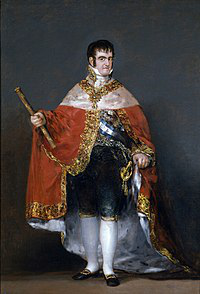
King of Spain (1784-1833) (r. 1808;1813-1833) King of Spain Ferdinand VIIFerdinand VII in Court Dress by Goya, 1815King of Spain (more...) 1st reign19 March 1808 – 6 May 1808PredecessorCharles IVSuccessorJoseph I2nd reign11 December 1813 – 29 September 1833PredecessorJoseph ISuccessorIsabella IITitular Emperor of Mexico (Treaty of Cordoba)Reign28 September 1821 – 18 May 1822SuccessorAgustin ITitular King of Chile (1812 Chilean Constitution)Reign27 October 1812 – 6 October 1813Titular King of Cundinamarca (1811 Constitution of Cundinamarca)Reign4 April 1811 – 19 September 1812Titular King of the United Provinces of the Río de La Plata (1811 Provisional Statute of Argentina)Reign25 May 1810 - 9 July 1816Born14 October 1784 El Escorial, SpainDied29 September 1833(1833-09-29) (aged 48) Madrid, SpainBurialEl EscorialSpouses Princess Maria Antonia of Naples and Sicily (m. 1802 ; died 1806 ) Infanta Maria Isabel of Portugal (m. 1816 ; died 1818 ) Princess Maria Josepha of Saxony (m. 1819 ; died 1829 ) Princess Maria Christina of the Two Sicilies (m. 1829 ) Issue see detail... Isabella II of Spain Infanta Luisa Fernanda, Duchess of MontpensierHouseBourbonFatherCharles IV of SpainMotherMaria Luisa of ParmaReligionRoman CatholicismSignature Ferdinand VII (Spanish: Fernando; 14 October 1784 – 29 September 1833) was the King of Spain during the early- to mid-19th century. He reigned over the Spanish Kingdom in 1808 and again from 1813 to his death in 1833. He was known to his supporters as el Deseado (the Desired) and to his detractors as el Rey Felón (the Felon King). Born in Madrid at El Escorial, Ferdinand VII spent his youth as heir apparent to the Spanish throne. Following the 1808 Tumult of Aranjuez, he ascended the throne. That year Napoleon overthrew him; he linked his monarchy to counter-revolution and reactionary policies that produced a deep rift in Spain between his forces on the right and liberals on the left. Back in power in December 1813, he reestablished the absolutist monarchy and rejected the liberal constitution of 1812. A revolt in 1820 led by Rafael del Riego forced him to restore the constitution thus beginning the Liberal Triennium: a three-year period of liberal rule. In 1823 the Congress of Verona authorized a successful French intervention restoring him to absolute power for the second time. He suppressed the liberal press from 1814 to 1833, jailing many of its editors and writers. Under his rule, Spain lost nearly all of its American possessions, and the country entered into a large-scale civil war upon his death. His political legacy has remained contested since his passing, with some historians regarding him as incompetent, despotic, and short-sighted.
We use cookies
We use cookies and other tracking technologies to improve your browsing experience on our website, to show you personalized content and targeted ads, to analyze our website traffic, and to understand where our visitors are coming from. Privacy Policy.