

 Today: 23 October, Friday 12:38
in Paris
Today: 23 October, Friday 12:38
in Paris


Duke of Burgundy
31 July 1396 Dijon, Duchy of Burgundy
15 June 1467(1467-06-15) (70) Bruges, Flanders, Burgundian Netherlands
10 May 1932 – 11 July 1940
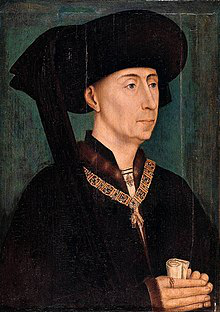
15th-century Duke of Burgundy For the engineer, see Philippe Lebon. Duke of Burgundy Philip the Good (French: Philippe le Bon; Dutch: Filips de Goede; 31 July 1396 – 15 June 1467) was Duke of Burgundy from 1419 until his death. He was a member of a cadet line of the Valois dynasty, to which all 15th-century kings of France belonged. During his reign, the Burgundian State reached the apex of its prosperity and prestige, and became a leading centre of the arts. Philip is known in history for his administrative reforms, his patronage of Flemish artists such as van Eyck and Franco-Flemish composers such as Guillaume Du Fay, and the capture of Joan of Arc. In political affairs, he alternated between alliances with the English and the French in an attempt to improve his dynasty's powerbase. Additionally, as ruler of Flanders, Brabant, Limburg, Artois, Hainaut, Holland, Luxembourg, Zeeland, Friesland and Namur, he played an important role in the history of the Low Countries.
We use cookies
We use cookies and other tracking technologies to improve your browsing experience on our website, to show you personalized content and targeted ads, to analyze our website traffic, and to understand where our visitors are coming from. Privacy Policy.






 Back
Back