

 Today: 29 July, Wednesday 02:32
in Kuala Lumpur
Today: 29 July, Wednesday 02:32
in Kuala Lumpur


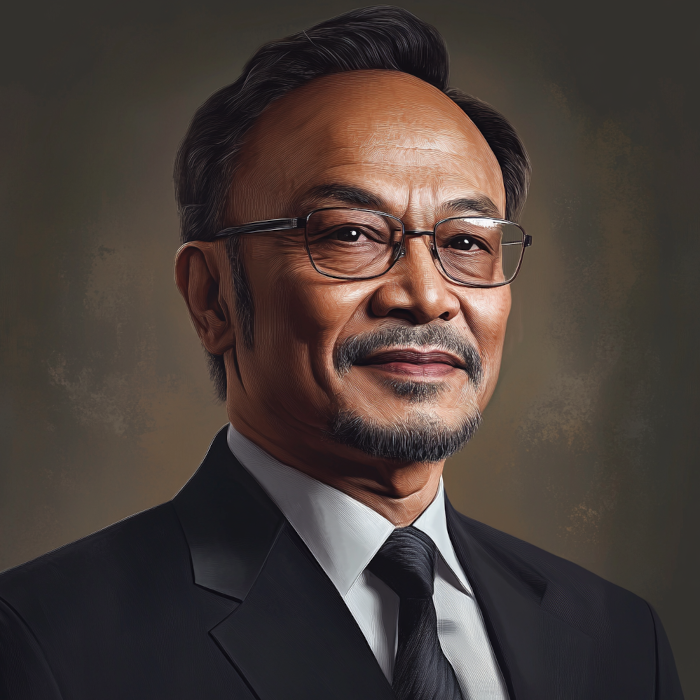
Anwar Ibrahim (born 1947) is a Malaysian politician who has played a central role in the country’s political landscape for several decades. As of 2022, he is serving as Prime Minister of Malaysia, after a long career marked by a dramatic series of political highs and lows, including his roles as Deputy Prime Minister, his fall from grace, imprisonment, and his eventual return to power. Anwar is known for his reformist agenda, his advocacy for democracy and justice, and his resilience in the face of political persecution. His career is intertwined with Malaysia's journey toward democratic governance and his own pursuit of justice and reform.
Birth and Family Background: Anwar Ibrahim was born on August 10, 1947, in Cherok Tok Kun, Penang, Malaysia, into a politically active family. His father, Ibrahim Abdul Rahman, was a member of the United Malays National Organisation (UMNO), while his mother, Che Yan, was known for her charitable work. Anwar’s early exposure to politics and social issues shaped his interest in public service.
Education and Activism: Anwar attended the prestigious Malay College Kuala Kangsar before pursuing a degree in Malay Studies at the University of Malaya. As a student, Anwar became involved in activism, championing issues such as poverty alleviation, education reform, and Islamic values. He was a charismatic leader in the Angkatan Belia Islam Malaysia (ABIM), a prominent Islamic youth movement. Anwar’s activism earned him widespread recognition, but also brought him into conflict with the government. In 1974, he was arrested and detained under the Internal Security Act (ISA) for participating in protests against poverty and government policies.
Entry into UMNO: Despite his earlier activism and criticism of the government, Anwar joined UMNO, the ruling political party, in 1982 under the encouragement of then-Prime Minister Mahathir Mohamad. Mahathir saw in Anwar a potential future leader with strong grassroots appeal, particularly among Malaysia’s Muslim population. Anwar’s decision to join UMNO was seen as surprising by many of his supporters, but he viewed it as a pragmatic move to influence change from within the system.
Rapid Political Rise: Once inside UMNO, Anwar rose quickly through the ranks. He held several ministerial positions, including Minister of Culture, Youth, and Sports, Minister of Agriculture, and Minister of Education. Anwar’s rise to national prominence was swift, and his charisma and vision for a more just and equitable Malaysia won him many supporters.
In 1993, Anwar was appointed Deputy Prime Minister and Minister of Finance, cementing his status as Mahathir’s likely successor. As Finance Minister, Anwar earned praise for his prudent economic management, particularly during the early stages of the Asian Financial Crisis in 1997. He implemented fiscal tightening measures and promoted transparency and good governance, policies that aligned with his reformist ideals.
Clash with Mahathir: Despite their earlier alliance, tensions between Anwar and Mahathir escalated during the Asian Financial Crisis. Anwar favored adopting the International Monetary Fund (IMF)'s economic recommendations, including austerity measures and economic reforms, while Mahathir rejected IMF interference and pursued a more unorthodox approach, including capital controls. Their disagreement over how to handle the crisis led to a political rift.
Reformasi Movement: In 1998, Anwar was dismissed from his positions as Deputy Prime Minister and Finance Minister, and he was subsequently expelled from UMNO. Anwar’s dismissal led to mass protests, known as the Reformasi (Reformation) movement, which called for democratic reforms, an end to corruption, and greater transparency in government. Anwar became the face of this movement, and his call for political change resonated with many Malaysians who were frustrated with the entrenched political elite.
Arrest and Imprisonment: Shortly after his dismissal, Anwar was arrested on charges of corruption and sodomy, allegations that he and his supporters believed were politically motivated to prevent him from challenging Mahathir’s rule. In 1999, Anwar was convicted of corruption and sentenced to six years in prison. He was later convicted of sodomy in a separate trial, extending his imprisonment by nine years. Anwar’s trial was widely criticized by human rights groups and international observers, who viewed it as a politically motivated effort to discredit him and eliminate him as a political rival.
Release from Prison (2004): In 2004, Anwar’s sodomy conviction was overturned by the Federal Court of Malaysia, and he was released from prison after serving six years. His release marked the beginning of his political comeback. Anwar reentered politics with a renewed commitment to reform and justice. He became the de facto leader of the People's Justice Party (Parti Keadilan Rakyat, PKR), which had been founded by his wife, Wan Azizah Wan Ismail, during his imprisonment.
Leadership of Pakatan Rakyat: Anwar played a central role in uniting Malaysia’s opposition forces under the umbrella of Pakatan Rakyat (People's Alliance), a coalition of parties that included the PKR, the Democratic Action Party (DAP), and the Pan-Malaysian Islamic Party (PAS). In the 2008 general election, Anwar led the opposition to its most significant electoral success to date, winning a substantial number of parliamentary seats and denying the ruling UMNO coalition a two-thirds majority for the first time in decades. This election marked a turning point in Malaysian politics, signaling the growing strength of the opposition.
Second Sodomy Trial (2010–2015): Despite his political resurgence, Anwar’s career was once again threatened by new allegations of sodomy in 2008. He was arrested and charged for a second time, a move that was widely seen as an attempt to derail his political comeback. Anwar maintained his innocence, and the case became a focal point for his supporters, who saw it as part of a broader campaign to silence political dissent.
In 2012, Anwar was acquitted of the sodomy charges, but the government appealed the ruling. In 2014, the Court of Appeal overturned the acquittal, and in 2015, Anwar was convicted and sentenced to five years in prison. His imprisonment sparked international condemnation, with human rights organizations and foreign governments calling for his release.
Alliance with Mahathir and Pakatan Harapan: In a surprising political turn, Anwar’s former mentor and rival, Mahathir Mohamad, reentered the political scene and joined forces with Anwar’s opposition coalition, now called Pakatan Harapan (Alliance of Hope). Mahathir had become disillusioned with the government of Prime Minister Najib Razak, who was implicated in the massive 1MDB corruption scandal. Mahathir agreed to lead the opposition coalition in the 2018 general election, with the promise of stepping down and handing over the premiership to Anwar once he was released from prison.
2018 General Election and Release: In May 2018, Pakatan Harapan achieved a historic victory in the general election, defeating Najib Razak’s Barisan Nasional coalition, which had ruled Malaysia since independence in 1957. The election marked the first time the ruling coalition had been unseated, and Mahathir, at the age of 92, was sworn in as prime minister for the second time. Anwar, still in prison, was granted a royal pardon shortly after the election, allowing him to return to political life.
Path to Premiership: Following his release, Anwar became actively involved in politics once again, although Mahathir remained prime minister. Tensions within the Pakatan Harapan coalition over the timing of the promised transition of power from Mahathir to Anwar caused political instability. In February 2020, Mahathir abruptly resigned, leading to a political crisis. Anwar’s path to the premiership was delayed as a new coalition government, led by Muhyiddin Yassin, took power. Despite the setback, Anwar remained a key figure in opposition politics, continuing to advocate for democratic reforms.
2022 General Election and Premiership: After years of political maneuvering and the collapse of several governments, Anwar Ibrahim finally became the 10th Prime Minister of Malaysia in November 2022 following a closely contested general election. Pakatan Harapan emerged as the largest coalition in the election, though it did not win an outright majority. Anwar was able to form a unity government with the support of various political parties and was sworn in as prime minister, marking the culmination of his decades-long struggle to lead Malaysia.
Anwar's premiership is seen as the realization of the Reformasi movement's goals for greater political transparency, social justice, and economic equality. His government faces significant challenges, including managing Malaysia's post-pandemic economic recovery, addressing racial and religious tensions, and maintaining the stability of his coalition government.
Anwar’s long struggle for political reform, both inside and outside of government, has been instrumental in shaping Malaysia’s democratic development. His eventual rise to the premiership in 2022 stands as a testament to his resilience and his enduring influence on the country's political future. As prime minister, Anwar faces the challenge of leading a diverse and divided nation, but his leadership offers the hope of advancing Malaysia toward greater unity, justice, and reform.
We use cookies
We use cookies and other tracking technologies to improve your browsing experience on our website, to show you personalized content and targeted ads, to analyze our website traffic, and to understand where our visitors are coming from. Privacy Policy.







 Back
Back