


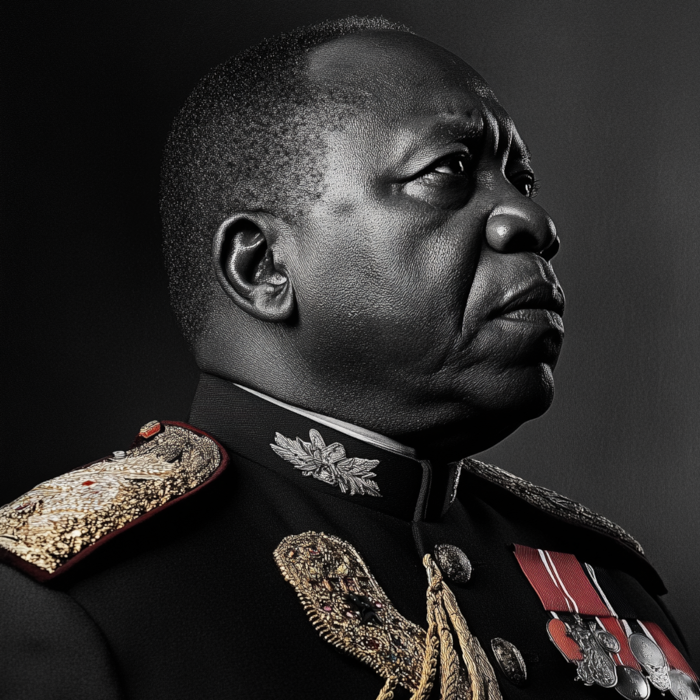
Idi Amin Dada (circa 1925 – 2003) was a Ugandan military officer who became the third President of Uganda, ruling from 1971 to 1979. His regime is remembered as one of the most brutal and tyrannical in African history, marked by widespread human rights abuses, political repression, ethnic persecution, and economic mismanagement. Amin’s reign of terror led to the deaths of an estimated 300,000 Ugandans and left the country in a state of economic ruin and social chaos.
Birth: Idi Amin was born around 1925 in Koboko, in the West Nile region of Uganda, which was then a British protectorate. His exact birth date is uncertain. Amin was of mixed Kakwa and Nubian descent.
Early Life: Amin had little formal education and spent his early years working as a laborer and as a cook's assistant. In 1946, he joined the King's African Rifles (KAR), a regiment of the British colonial army, where he began his military career.
Military Service: Amin quickly rose through the ranks due to his physical strength, courage, and leadership abilities. He served in several military campaigns, including the British suppression of the Mau Mau uprising in Kenya in the 1950s. By the time Uganda gained independence from Britain in 1962, Amin had achieved the rank of lieutenant.
Role in Post-Independence Uganda: After independence, Amin continued to rise in the Ugandan military, becoming a close ally of Prime Minister Milton Obote. In 1966, he played a key role in Obote’s coup against President Edward Mutesa, helping Obote consolidate power. Amin was rewarded with a promotion to major general and was appointed commander of the Ugandan army.
Coup d'État: In January 1971, while Obote was attending a Commonwealth conference in Singapore, Amin seized power in a military coup. He accused Obote of corruption and divisive policies, presenting himself as a savior of Uganda. The coup was initially welcomed by many Ugandans who were disillusioned with Obote’s government.
Consolidation of Power: After taking control, Amin quickly moved to consolidate his power by purging the military of Obote’s supporters and executing or imprisoning perceived opponents. He declared himself President and began ruling by decree, dissolving parliament and suspending the constitution.
Human Rights Abuses: Amin’s regime became notorious for its extreme brutality. He established a network of secret police and military units that carried out widespread extrajudicial killings, torture, and disappearances. Victims included political opponents, ethnic minorities, religious leaders, intellectuals, and suspected dissenters. Entire ethnic groups, such as the Acholi and Lango, were targeted for persecution.
Expulsion of Asians: In 1972, Amin ordered the expulsion of Uganda’s Asian minority, who were mainly of Indian descent. Over 50,000 people were forced to leave the country within 90 days, leaving behind their businesses and property. This decision was motivated by Amin’s desire to redistribute wealth and by his belief that Asians were exploiting Uganda’s economy. However, the expulsion led to the collapse of Uganda’s economy, as the expelled community had been instrumental in trade and industry.
Foreign Relations and Self-Styled Titles: Amin declared himself "Conqueror of the British Empire" and bestowed upon himself a range of grandiose titles, including "His Excellency President for Life, Field Marshal Al Hadji Doctor Idi Amin Dada, VC, DSO, MC, Lord of All the Beasts of the Earth and Fishes of the Sea." His erratic and unpredictable behavior, along with his eccentricity, made him a subject of international media attention.
International Isolation: Under Amin’s rule, Uganda became increasingly isolated on the international stage. Relations with Western countries deteriorated, and his regime became aligned with the Soviet Union, Libya under Muammar Gaddafi, and Palestinian militant groups. Amin’s support for these groups, including his harboring of terrorists, further alienated him from the West.
Economic Collapse: Amin’s policies, including the expulsion of Asians and the nationalization of foreign-owned businesses, led to the collapse of Uganda’s economy. The country faced severe shortages of basic goods, hyperinflation, and widespread corruption. The once-thriving agricultural and manufacturing sectors were decimated.
Internal Rebellions: As economic conditions worsened and repression increased, various groups within Uganda began to resist Amin’s rule. His regime faced multiple coup attempts and insurgencies, but these were brutally suppressed.
Invasion of Tanzania and Downfall: In October 1978, Amin’s forces invaded Tanzania, attempting to annex the Kagera region. The invasion backfired as Tanzanian President Julius Nyerere launched a counteroffensive with the help of Ugandan exiles. In 1979, Tanzanian forces, along with Ugandan rebels, captured Kampala, Uganda’s capital, forcing Amin to flee.
Exile: After his ouster, Amin fled to Libya, and later settled in Saudi Arabia, where he lived in exile for the rest of his life. He was provided with a comfortable life by the Saudi government on the condition that he stayed out of politics.
Death: Idi Amin died on August 16, 2003, in Jeddah, Saudi Arabia, after a prolonged illness. His death marked the end of a notorious chapter in Uganda’s history.
Legacy: Amin’s legacy is one of brutality, fear, and economic destruction. His regime is remembered as one of the most violent and repressive in African history. The scars left by his rule are still felt in Uganda, and he is widely regarded as a symbol of tyranny. However, some people in Uganda, particularly in the West Nile region, remember him for his charisma and his efforts to promote African identity and culture, albeit in a deeply flawed manner.
Film and Literature: Idi Amin’s life and regime have been the subject of numerous books, documentaries, and films. The most famous portrayal of Amin is in the 2006 film The Last King of Scotland, where Forest Whitaker’s portrayal of Amin won an Academy Award for Best Actor. The film, while fictionalized, captures the atmosphere of terror during Amin’s rule.
In Popular Memory: Amin remains a controversial figure in Uganda and beyond. While his rule is overwhelmingly condemned, there are small groups and individuals who view him with nostalgia, particularly for his defiance of Western powers and his initial attempts at economic redistribution.
Idi Amin’s rule serves as a cautionary tale about the dangers of authoritarianism, the abuse of power, and the consequences of unchecked brutality. His regime's impact on Uganda continues to be a subject of study and reflection, both within the country and globally.
We use cookies
We use cookies and other tracking technologies to improve your browsing experience on our website, to show you personalized content and targeted ads, to analyze our website traffic, and to understand where our visitors are coming from. Privacy Policy.