


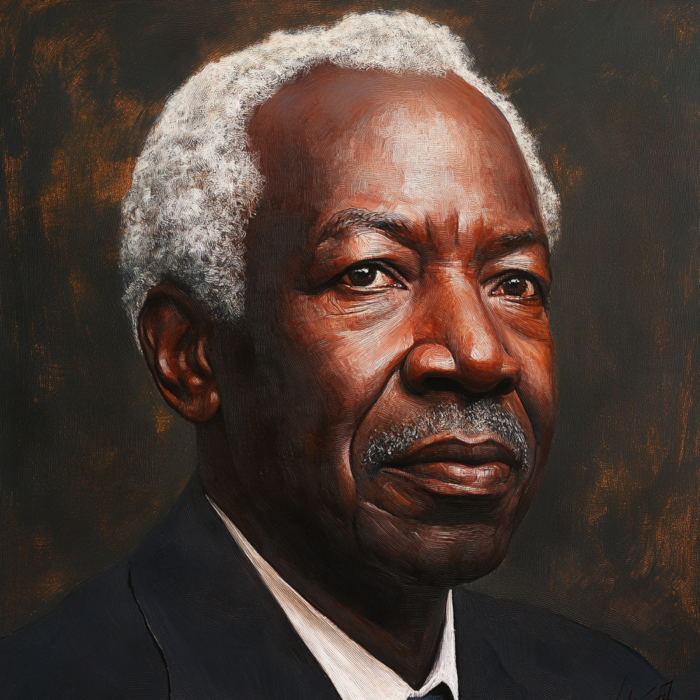
Julius Kambarage Nyerere (1922–1999) was a Tanzanian anti-colonial activist, politician, and philosopher who served as the first President of Tanzania from 1964 to 1985. He is considered one of the founding fathers of modern Africa and a leading advocate for Pan-Africanism and African socialism. Nyerere's vision of self-reliance, social equality, and unity shaped the political and social landscape of Tanzania and left a lasting impact on the African continent.
Return to Tanganyika: After returning to Tanganyika in 1952, Nyerere became a teacher and began to engage in political activism. He quickly emerged as a leader in the movement for independence from British colonial rule.
Founding of TANU: In 1954, Nyerere founded the Tanganyika African National Union (TANU), a political party dedicated to achieving independence and promoting African unity. TANU grew rapidly under Nyerere's leadership, mobilizing widespread support across the country.
Path to Independence: Nyerere's strategy for independence was based on nonviolent resistance and negotiation. He believed in building a broad-based movement that included people from all ethnic groups and social classes. His moderate and inclusive approach, along with his ability to negotiate with the British authorities, helped Tanganyika achieve a relatively peaceful transition to independence.
Independence: On December 9, 1961, Tanganyika gained independence from Britain, with Nyerere serving as the country's first Prime Minister. In 1962, Tanganyika became a republic, and Nyerere was elected its first President.
Formation of Tanzania: In 1964, Tanganyika united with the island of Zanzibar to form the United Republic of Tanzania, with Nyerere as its first President. This union was seen as a symbol of African unity and was part of Nyerere's broader vision of Pan-Africanism.
Ujamaa and African Socialism: Nyerere is best known for his philosophy of "Ujamaa," a Swahili word meaning "familyhood" or "brotherhood." Ujamaa was the foundation of Nyerere's vision for African socialism, which emphasized communal ownership, self-reliance, and social equality. Under the Arusha Declaration of 1967, Nyerere implemented Ujamaa as the official policy of the state, which included the nationalization of key industries, the creation of collective villages (Ujamaa villages), and a focus on rural development.
Education for Self-Reliance: Nyerere placed a strong emphasis on education as a tool for social transformation. He promoted the idea of "Education for Self-Reliance," which aimed to make education more relevant to the needs of rural communities and to instill values of self-reliance, cooperation, and social responsibility.
Pan-Africanism and Foreign Policy: Nyerere was a leading advocate for Pan-Africanism, the idea of a united and self-reliant Africa. He supported liberation movements across the continent and played a key role in the formation of the Organization of African Unity (OAU) in 1963. Nyerere also pursued a non-aligned foreign policy, maintaining independence from both Western and Eastern blocs during the Cold War.
Economic Difficulties: Despite Nyerere's visionary leadership, his policies, particularly Ujamaa, faced significant challenges. The forced villagization program, which aimed to relocate rural populations into collective villages, was met with resistance and often led to decreased agricultural productivity. The nationalization of industries also resulted in inefficiency and economic stagnation. By the late 1970s, Tanzania's economy was in crisis, with high levels of debt, inflation, and unemployment.
Human Rights and Political Repression: Nyerere's government was a one-party state, with TANU as the sole legal party. While Nyerere was generally seen as a benevolent leader, his government did suppress political opposition, and there were instances of human rights abuses, particularly in response to resistance to the Ujamaa policies.
Legacy of Ujamaa: Nyerere's Ujamaa policies are still debated today. Supporters argue that his focus on social equity, education, and rural development laid the foundations for a cohesive and relatively stable society. Critics, however, point to the economic failures and inefficiencies that resulted from the implementation of Ujamaa, arguing that it contributed to prolonged poverty in the country.
Voluntary Retirement: In 1985, Nyerere made the rare decision to voluntarily step down from power, making way for his successor, Ali Hassan Mwinyi. Nyerere's retirement was seen as a significant act of humility and statesmanship in a region where leaders often clung to power. After his retirement, Nyerere continued to play an influential role in Tanzanian politics as the "Father of the Nation."
Continued Involvement in African Affairs: Even after stepping down as president, Nyerere remained active in African and global affairs. He served as a mediator in various African conflicts, including the Burundi civil war, and continued to advocate for African unity and development.
Death: Julius Nyerere died on October 14, 1999, in London, United Kingdom, from leukemia. His death was widely mourned in Tanzania and across Africa, with many recognizing him as a principled leader who dedicated his life to the betterment of his people and the continent.
Father of the Nation: In Tanzania, Nyerere is revered as the "Father of the Nation" (Baba wa Taifa). His contributions to Tanzanian independence, national unity, and social development are celebrated, and his birthday, April 13, is observed as Nyerere Day.
Mwalimu (The Teacher): Nyerere was affectionately known as "Mwalimu," meaning "The Teacher" in Swahili, reflecting his background in education and his belief in the importance of knowledge and moral leadership. His writings and speeches continue to be studied and respected in Tanzania and beyond.
Critique and Respect: While Nyerere's policies, particularly Ujamaa, are subject to critique, he is widely respected for his integrity, his commitment to social justice, and his vision for a united and self-reliant Africa. His leadership style, characterized by humility and a genuine concern for his people, remains an example for African leaders.
Global Influence: Nyerere's influence extended beyond Tanzania. He was a leading figure in the Non-Aligned Movement and a strong advocate for global justice and equality. His legacy continues to inspire movements for social justice and Pan-Africanism.
Julius Nyerere's life and work have left an indelible mark on Tanzania and Africa. His vision of a united, self-reliant, and equitable society, though imperfectly realized, continues to resonate in discussions about development, governance, and social justice in Africa and around the world.
We use cookies
We use cookies and other tracking technologies to improve your browsing experience on our website, to show you personalized content and targeted ads, to analyze our website traffic, and to understand where our visitors are coming from. Privacy Policy.