

 Today: 30 May, Saturday 01:00
in Nay Pyi Taw
Today: 30 May, Saturday 01:00
in Nay Pyi Taw


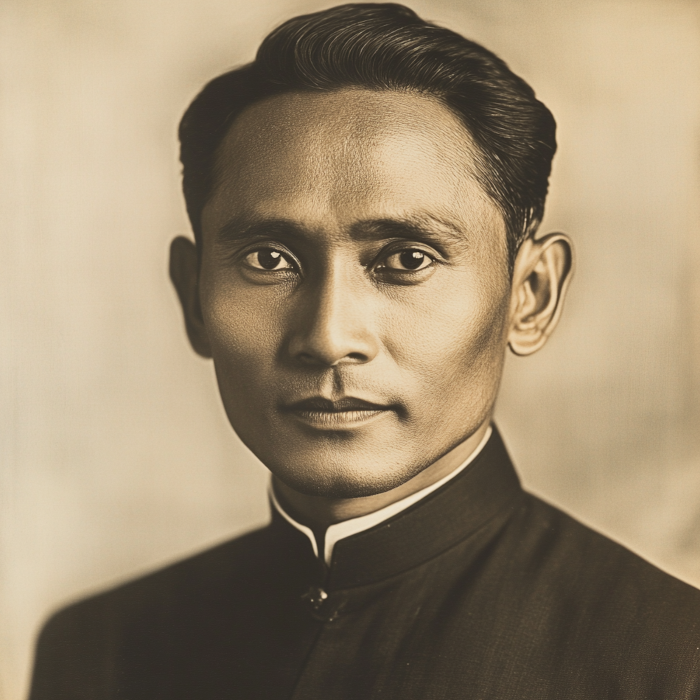
Aung San (1915–1947) was a Burmese nationalist leader and revolutionary who played a pivotal role in Myanmar's struggle for independence from British colonial rule. He is regarded as the "Father of Modern Myanmar" and is celebrated for his role in leading the independence movement that resulted in the end of British colonialism in 1948. Aung San was also a founder of the Tatmadaw (Myanmar's military) and played a key role in negotiating Burma's postwar independence from Britain. His assassination in 1947, just months before Burma gained its independence, marked the end of a brief but transformative political career.
Birth and Background: Aung San was born on February 13, 1915, in Natmauk, in Magway Region, in British Burma (now Myanmar). He was the youngest of six children in a family with a strong tradition of public service. His father was a government official who had served as a district officer, and Aung San grew up with a sense of responsibility towards his community.
Education and Political Awakening: Aung San attended Rangoon University (now the University of Yangon), where he studied law and became politically active. He was drawn to nationalist ideas and was soon elected as the general secretary of the Rangoon University Students' Union (RUSU). His leadership in student protests against colonial policies marked his early commitment to Burmese independence and led to his expulsion from the university. This experience fueled his desire to fight against colonial rule.
Founding the Thakin Movement: In the 1930s, Aung San became a founding member of the Dobama Asiayone (We Burmans Association), also known as the Thakin Movement. The term "Thakin," meaning "master," was adopted by the group as a challenge to the British colonialists, who expected to be called "Thakin" by their Burmese subjects. The Thakin Movement sought to assert Burmese national identity and agitate for independence. Aung San and the Thakins believed that Burma should be ruled by its own people and were willing to take radical measures to achieve their goal.
Formation of the Communist Party: In 1939, Aung San co-founded the Communist Party of Burma (CPB), reflecting his belief in socialism and revolutionary change. However, his approach to achieving independence was pragmatic, and he was willing to work with various ideologies and foreign powers to realize the dream of a free Burma.
Japan and the Burma Independence Army: When World War II broke out, Aung San sought help from Japan to achieve independence from Britain. He and a group of young nationalists known as the Thirty Comrades traveled to Japan in 1941, where they received military training. With Japanese support, Aung San and the Thirty Comrades formed the Burma Independence Army (BIA) and launched operations against British forces when the Japanese invaded Burma in 1942. Aung San initially believed that Japan would help Burma achieve independence, but it soon became clear that Japanese rule was just as oppressive as British colonialism.
Turning Against Japan: By 1944, Aung San realized that Japan had no intention of granting genuine independence to Burma. He began secret negotiations with the Allied forces and, in 1945, led the Anti-Fascist People's Freedom League (AFPFL) in a revolt against the Japanese. The Allied forces, with the help of the AFPFL and the reconstituted Burma National Army (BNA), successfully drove the Japanese out of Burma. This shift from collaboration with Japan to cooperation with the Allies earned Aung San a reputation as a nationalist leader who prioritized Burma's independence above all else.
Formation of the Anti-Fascist People's Freedom League (AFPFL): In 1944, Aung San co-founded the Anti-Fascist People's Freedom League (AFPFL), an alliance of nationalist groups, communists, and socialists that united against Japanese occupation and later became the driving force behind Burma's push for independence from British rule. The AFPFL became the leading political force in Burma and played a key role in mobilizing popular support for independence.
Negotiating with the British: After World War II ended, Aung San shifted his focus to negotiating Burma's independence from Britain. He was appointed Deputy Chairman of the Executive Council of Burma, a transitional government that was established to prepare the country for independence. In 1947, Aung San traveled to London to negotiate with British Prime Minister Clement Attlee. The negotiations were successful, and the Aung San-Attlee Agreement was signed, setting a timeline for Burma's independence. The agreement represented a major breakthrough and showed Aung San's ability to navigate the complexities of diplomacy with a colonial power.
Panglong Agreement: Aung San also played a critical role in uniting the diverse ethnic groups within Burma. In February 1947, he led negotiations with ethnic minority leaders at the Panglong Conference, resulting in the Panglong Agreement. The agreement, signed on February 12, 1947, was a landmark in Burma's history, as it guaranteed autonomy and equal rights for the ethnic minority regions in exchange for their support for independence. Union Day, which commemorates the signing of the Panglong Agreement, is still celebrated in Myanmar today as a symbol of national unity.
Assassination: On July 19, 1947, Aung San and several members of his cabinet were assassinated during a meeting of the Executive Council. The assassination was carried out by armed men, allegedly ordered by U Saw, a political rival and former prime minister. Aung San's death was a tremendous blow to the country, coming just months before Burma was set to gain independence. He was only 32 years old at the time of his death. Martyrs' Day is observed annually in Myanmar on July 19 to honor Aung San and his colleagues who were assassinated.
Father of Independence: Despite his untimely death, Aung San is widely regarded as the Father of Independence in Myanmar. His efforts laid the groundwork for Burma's independence, which was achieved on January 4, 1948. Aung San's leadership and vision were crucial in uniting the country and negotiating a peaceful transition to self-rule. His commitment to national unity and independence continues to be a source of inspiration for many in Myanmar.
Father of Aung San Suu Kyi: Aung San is also known internationally as the father of Aung San Suu Kyi, the Nobel Peace Prize laureate and pro-democracy leader who has played a significant role in Myanmar's modern history. Aung San Suu Kyi has often cited her father's legacy as an inspiration for her own political career and struggle for democracy in Myanmar.
Symbol of National Unity: Aung San's legacy as the architect of Burmese independence and a symbol of national unity endures in Myanmar. He is remembered for his determination to achieve self-rule, his efforts to build a united country, and his commitment to social and economic reforms. His portrait is prominently displayed across the country, and his speeches and writings continue to be studied and revered by many.
Panglong Vision and Ethnic Unity: Aung San's vision for a unified Burma, as exemplified by the Panglong Agreement, remains a cornerstone of his legacy. He believed in the importance of building a federal system that respected the autonomy of the country's various ethnic groups while maintaining national unity. Although the vision of ethnic equality and unity has yet to be fully realized in Myanmar, Aung San's efforts at Panglong serve as a reminder of the potential for peaceful coexistence among the country's diverse communities.
Political Legacy and Influence: Aung San's political legacy has been a defining influence on Myanmar's modern political history. His advocacy for democracy, socialism, and social equality inspired future generations of political leaders, including members of the Anti-Fascist People's Freedom League (AFPFL) and the National League for Democracy (NLD), founded by his daughter Aung San Suu Kyi. His vision for an independent and united Burma has continued to shape the country's political discourse, even as Myanmar has faced ongoing challenges related to governance, ethnic conflict, and military rule.
Martyrs' Day: Every year on July 19, Myanmar commemorates Martyrs' Day to honor Aung San and his colleagues who were assassinated in 1947. The day serves as a reminder of the sacrifices made by Aung San and other leaders in the struggle for independence and highlights the importance of national unity and resilience.
Aung San was a revolutionary leader whose determination, vision, and sacrifices played an instrumental role in securing Myanmar's independence from British colonial rule. As the Father of Modern Myanmar, Aung San's contributions to the independence movement and his efforts to unite the country's diverse ethnic groups have left an enduring impact on Myanmar's national identity. His assassination in 1947 cut short a promising political career, but his legacy as a unifier and champion of independence continues to inspire generations of Myanmar's people.
Aung San's ideals of democracy, national unity, and independence remain central to Myanmar's identity, even as the country faces challenges in achieving the vision he set forth. His daughter, Aung San Suu Kyi, has carried forward his legacy in her own struggle for democracy in Myanmar, and the memory of Aung San continues to be a powerful symbol of hope and inspiration for those seeking a better future for the country.
We use cookies
We use cookies and other tracking technologies to improve your browsing experience on our website, to show you personalized content and targeted ads, to analyze our website traffic, and to understand where our visitors are coming from. Privacy Policy.







 Back
Back