

 Today: 27 May, Wednesday 03:02
in Nay Pyi Taw
Today: 27 May, Wednesday 03:02
in Nay Pyi Taw


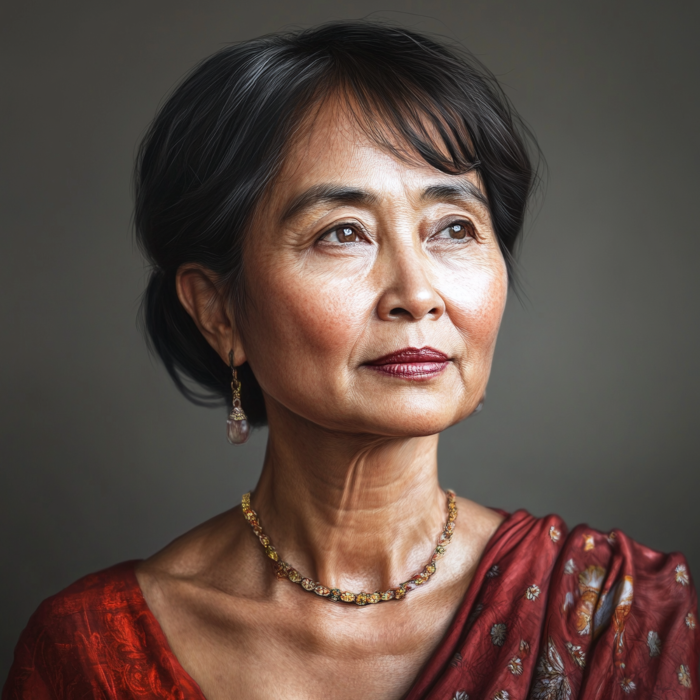
Aung San Suu Kyi is a prominent political figure from Myanmar (formerly Burma) known for her pro-democracy activism, leadership, and controversial role in the country’s politics. She has been an international symbol of peaceful resistance in the face of oppression, having spent many years under house arrest. However, her legacy has become more complex due to her later role in Myanmar's government and her controversial stance on human rights issues, particularly concerning the Rohingya crisis.
Suu Kyi was educated in Burma until she was 15, after which she studied abroad. She attended Lady Shri Ram College in New Delhi, India, and later graduated from the University of Oxford with a degree in philosophy, politics, and economics (PPE). She also studied at the School of Oriental and African Studies (SOAS) in London.
In 1988, Aung San Suu Kyi returned to Myanmar to care for her ailing mother. That year marked the beginning of widespread pro-democracy protests against the military government, which had ruled the country since 1962. Suu Kyi quickly became involved in the movement, drawing on the legacy of her father to rally the Burmese people for democratic reforms.
Founding of the NLD: In September 1988, she co-founded the National League for Democracy (NLD), a political party that called for nonviolent struggle for democracy and human rights in Myanmar. She became the party's General Secretary and quickly emerged as the leader of the pro-democracy movement.
House Arrest: In July 1989, the military government placed Suu Kyi under house arrest. Despite her detention, the NLD won a landslide victory in the 1990 general elections, securing 81% of the parliamentary seats. However, the military junta refused to recognize the results and continued to detain Suu Kyi.
Suu Kyi spent approximately 15 of the next 21 years under house arrest, during which she became an international symbol of resistance to oppression. Her situation drew global attention, leading to widespread calls for her release from international organizations, governments, and activists.
In 1991, Aung San Suu Kyi was awarded the Nobel Peace Prize for her nonviolent struggle for democracy and human rights. She was unable to collect the award in person, as she was still under house arrest, but her sons accepted it on her behalf.
The Nobel Committee described her as "an outstanding example of the power of the powerless," likening her struggle to that of Mahatma Gandhi. The prize brought further international recognition to her cause and highlighted the brutalities of Myanmar's military regime.
Suu Kyi was finally released from house arrest in November 2010, following international pressure and a change in the military government's strategy. In the years following her release, Myanmar began a series of political reforms that included the relaxation of press censorship, the release of political prisoners, and the initiation of dialogue with opposition groups.
Parliamentary Elections: In 2012, Aung San Suu Kyi and the NLD participated in by-elections, where she won a seat in the Burmese parliament. This marked her first formal entry into the political process after decades of struggle.
General Elections and Leadership: In the 2015 general elections, the NLD won a decisive victory, securing a majority in both houses of parliament. However, due to a constitutional clause that barred her from becoming president (because her late husband and children are foreign nationals), Suu Kyi assumed the newly created position of State Counsellor, effectively becoming the de facto leader of Myanmar.
Aung San Suu Kyi's international reputation suffered significantly due to her handling of the Rohingya crisis. Beginning in 2017, Myanmar's military launched a brutal crackdown on the Rohingya Muslim minority in Rakhine State, leading to widespread allegations of genocide, mass killings, and forced displacement. Over 700,000 Rohingya fled to neighboring Bangladesh, creating a severe humanitarian crisis.
International Criticism: Suu Kyi faced global condemnation for her perceived inaction and defense of the military's actions during the crisis. Critics accused her of failing to use her moral authority to stop the violence and of defending the military at international forums. This stance led to several honors and awards, including the Freedom of the City of Oxford, being revoked.
Defending Myanmar: In 2019, Suu Kyi personally appeared before the International Court of Justice (ICJ) in The Hague to defend Myanmar against charges of genocide. Her defense of the military further tarnished her image internationally, though she retained significant support within Myanmar.
In February 2021, Myanmar’s military, known as the Tatmadaw, staged a coup, detaining Aung San Suu Kyi and other senior leaders of the NLD. The coup occurred following the NLD’s landslide victory in the 2020 general elections, which the military claimed were marred by fraud—a charge widely disputed by international observers.
Charges and Trials: Since the coup, Suu Kyi has faced numerous charges by the military junta, including corruption, violating state secrets, and electoral fraud. These trials have been widely regarded as politically motivated.
Current Status: As of 2024, Suu Kyi remains under detention, with her future uncertain amidst ongoing political turmoil in Myanmar. The military's actions have led to widespread protests and violence across the country, plunging Myanmar into further instability.
Aung San Suu Kyi’s legacy is complex and multifaceted. She remains a symbol of the struggle for democracy and human rights in Myanmar, despite the controversies surrounding her later years. Her earlier years of resistance against the military regime earned her global admiration, but her handling of the Rohingya crisis and her relationship with the military has significantly altered her international standing.
Within Myanmar, she continues to be a highly influential figure, with many viewing her as the embodiment of their aspirations for democracy, despite the challenges and criticisms that have marked her later political career.
We use cookies
We use cookies and other tracking technologies to improve your browsing experience on our website, to show you personalized content and targeted ads, to analyze our website traffic, and to understand where our visitors are coming from. Privacy Policy.







 Back
Back