

 Today: 24 August, Monday 12:16
in Moscow
Today: 24 August, Monday 12:16
in Moscow


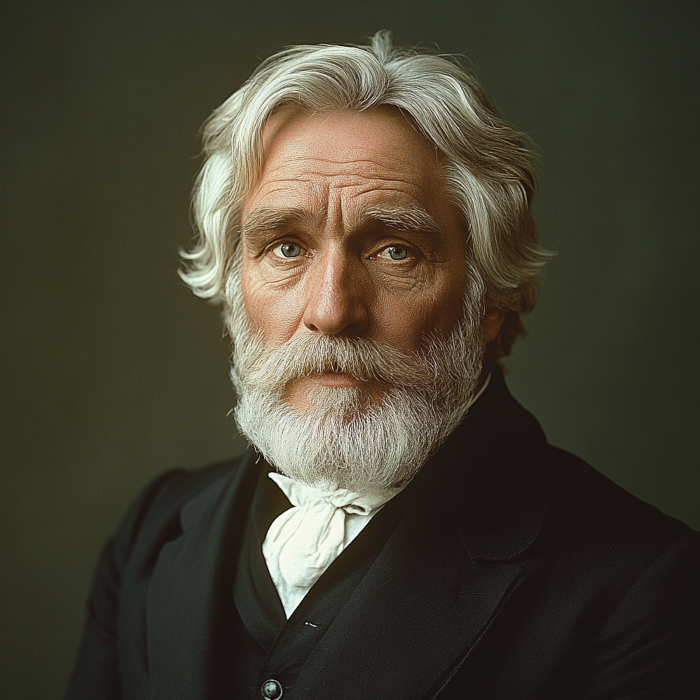
Ivan Sergeyevich Turgenev (1818–1883) was a Russian novelist, short story writer, and playwright who played a significant role in shaping Russian and European literature in the 19th century. He is best known for his novel "Fathers and Sons", which introduced the term "nihilism" and captured the tensions between generations in Russian society. Turgenev’s works are celebrated for their psychological depth, lyrical prose, and realistic portrayal of Russian life. He is often regarded as a key figure in the development of Russian realism and was admired for his depictions of the conflicts between progressive and conservative forces in society.
Birth and Family Background: Ivan Turgenev was born on October 9, 1818, in Oryol, in central Russia, into a wealthy landowning family. His father, Sergei Nikolaevich Turgenev, was a cavalry officer, and his mother, Varvara Petrovna Lutovinova, was an authoritarian and controlling woman. His mother’s tyrannical behavior, especially towards the family serfs, left a lasting impression on Turgenev and shaped his views on the injustices of serfdom. The vast estates owned by his mother provided the background for many of his stories, which often depicted rural life and social issues.
Education: Turgenev received a privileged education, attending Moscow University and later Saint Petersburg University, where he studied philosophy and literature. In 1838, he went to Berlin, where he studied philosophy and classical literature at the University of Berlin. During his time in Berlin, he was influenced by German Romanticism and the philosophies of Hegel and Schopenhauer, which had a profound impact on his worldview.
Influence of Russian Society and Serfdom: Turgenev began his literary career in the 1840s, during a period of significant social change in Russia. He was deeply affected by the plight of the serfs and was critical of the rigid class structures of Russian society. His early experiences witnessing the mistreatment of serfs by his mother inspired his advocacy for social reform, and he became one of the first Russian writers to openly depict the harsh realities of peasant life in his work.
"A Sportsman's Sketches" (1852): Turgenev's first major success came with "A Sportsman's Sketches" (also known as "Sketches from a Hunter's Album"), a collection of short stories published in 1852. These sketches are based on Turgenev’s travels through his family’s estates and are known for their lyrical descriptions of the Russian countryside and sympathetic portrayal of the serfs. The stories provided an unflinching look at the hardships endured by the peasantry, and their popularity contributed to a growing awareness of the need for social reform in Russia. "A Sportsman's Sketches" is often credited with influencing Tsar Alexander II's decision to emancipate the serfs in 1861.
"Rudin" (1856): "Rudin", published in 1856, was Turgenev’s first full-length novel. It tells the story of Dmitry Rudin, an intellectual and idealist whose inability to act on his ideals leaves him isolated and ineffective. The novel portrays the superfluous man, a common archetype in Russian literature of the time—an educated but indecisive individual who is unable to effect meaningful change. Rudin's character represents the conflict between ideals and action, a theme that recurs in many of Turgenev's works.
"A Nest of Gentlefolk" (1859): In "A Nest of Gentlefolk" (also known as "Home of the Gentry"), published in 1859, Turgenev explores themes of love, nostalgia, and disillusionment. The novel tells the story of Fyodor Lavretsky, a landowner who returns to Russia after spending years abroad and finds himself disillusioned with his past and yearning for a simpler, more meaningful life. The novel reflects Turgenev’s lyrical style and his exploration of the conflict between the desire for progress and the pull of tradition.
"On the Eve" (1860): "On the Eve", published in 1860, examines the social and political climate of Russia on the brink of major reforms. The novel centers on the love affair between Elena Stakhova, an idealistic young woman, and Dmitri Insarov, a Bulgarian revolutionary. The novel portrays the passionate commitment of Insarov to the revolutionary cause and contrasts it with the passivity of Russian society. "On the Eve" is often seen as a reflection of Turgenev's belief in the need for social change and the importance of decisive action.
"Fathers and Sons" (1862): "Fathers and Sons", published in 1862, is Turgenev’s most famous novel and one of the defining works of Russian literature. The novel captures the generational conflict between the older aristocracy, who are committed to traditional values, and the younger generation, represented by nihilists who reject all established institutions and beliefs. The character of Bazarov, the novel’s protagonist, is a nihilist and a revolutionary who challenges the values of the older generation. Through Bazarov, Turgenev introduces the concept of nihilism to literature, portraying it as both a necessary challenge to outdated traditions and a potentially destructive force. "Fathers and Sons" explores themes of change, generational conflict, and the tension between tradition and progress.
Life in Western Europe: Turgenev spent much of his later life living in Western Europe, particularly in France and Germany. He was a close friend of Gustave Flaubert and developed relationships with many prominent European writers, including Émile Zola, George Sand, and Henry James. Turgenev’s connections to the European literary community helped introduce Russian literature to the West and played a key role in bridging the cultural gap between Russia and Europe.
Conflict with Russian Literary Circles: Turgenev's relationship with other Russian writers, particularly Fyodor Dostoevsky and Leo Tolstoy, was often fraught. While Turgenev admired Tolstoy's talent, the two had a strained friendship and ideological differences, particularly regarding the role of the aristocracy and the peasantry in Russian society. Dostoevsky, on the other hand, viewed Turgenev's Western-influenced liberalism with suspicion and criticized his lack of deep spiritual engagement with Russian life. Despite these tensions, Turgenev remained a key figure in Russian literary circles and was respected for his contributions to literature.
"Smoke" (1867): In "Smoke", published in 1867, Turgenev satirizes the Russian aristocracy and the intelligentsia, depicting them as detached from reality and incapable of effecting meaningful change. The novel follows Litvinov, a young Russian man caught between his love for two women and his disillusionment with the social and political state of Russia. "Smoke" reflects Turgenev’s skepticism about the potential for reform in Russia and his frustration with the ideological conflicts of the time.
"Virgin Soil" (1877): "Virgin Soil", published in 1877, was Turgenev's last major novel. The book focuses on a group of young revolutionaries who attempt to incite social change among the Russian peasantry. The novel portrays the difficulties faced by the Populists—a movement committed to educating and mobilizing the peasantry—and reflects Turgenev's belief in the importance of social reform, even as he acknowledges the challenges and limitations of such efforts.
Psychological Realism: Turgenev is known for his psychological insight and the depth with which he portrays his characters. His works often focus on the inner lives of individuals, exploring their emotions, motivations, and conflicts. Unlike some of his contemporaries, Turgenev was less concerned with philosophical or religious questions and more interested in the personal and emotional struggles of his characters. His use of psychological realism made his characters feel relatable and human, which contributed to the lasting impact of his works.
Social and Political Themes: Turgenev was deeply concerned with the social and political issues of his time, particularly the plight of the serfs and the growing divide between liberal reformers and conservatives. His novels often depict the tensions between different social classes and the clash between traditional values and modern ideas. Turgenev's portrayal of these issues was marked by a sense of ambivalence—while he supported social reform, he was often skeptical of the effectiveness of revolutionary change and wary of the potential for violence.
Nature and the Russian Countryside: Turgenev's works are noted for their lyrical descriptions of nature and the Russian countryside. His writing often reflects a deep appreciation for the beauty of rural Russia, and his vivid descriptions of landscapes create a powerful sense of place. This focus on nature also serves as a counterpoint to the social conflicts and personal struggles of his characters, highlighting the enduring beauty of the natural world in contrast to the complexities of human life.
Final Years: Turgenev spent his later years living in Baden-Baden and Paris, often visiting Russia but spending most of his time in Western Europe. He became a prominent figure in European literary circles and was well respected by many of the leading writers and intellectuals of his time. He maintained a close and complicated friendship with the famous French singer Pauline Viardot, with whom he was deeply infatuated. Turgenev remained unmarried and childless, devoting his life to literature and his friendships.
Death: Ivan Turgenev died on September 3, 1883, in Bougival, near Paris, after suffering from spinal cancer. He was buried in Volkovo Cemetery in St. Petersburg, Russia. His death marked the end of an era in Russian literature, but his influence continued to be felt by future generations of writers.
Influence on Russian Realism: Ivan Turgenev is often regarded as one of the founders of Russian realism, and his works had a profound influence on the development of Russian literature. His focus on the conflicts between generations, social classes, and individuals helped shape the themes that would be explored by later writers, including Leo Tolstoy and Anton Chekhov. Turgenev’s emphasis on psychological depth and social issues laid the groundwork for the realist movement that would dominate Russian literature in the latter half of the 19th century.
Western Reception and Bridging Cultures: Turgenev was the first Russian author to achieve widespread recognition in Western Europe, and his works helped introduce Russian literature to a European audience. His close relationships with European writers like Gustave Flaubert and George Sand helped bridge the gap between Russian and Western literature, and his influence extended beyond Russia to inspire writers such as Henry James and Guy de Maupassant.
"Fathers and Sons" and the Nihilist Movement: Turgenev's "Fathers and Sons" remains one of his most important and influential works. The character of Bazarov, a nihilist who rejects all established values, became a symbol of the younger generation in Russia, challenging the traditions of their elders. The novel's exploration of the tension between liberal reformers and radical revolutionaries was highly relevant to Russian society at the time and continues to resonate with readers as a powerful depiction of generational conflict.
Ivan Turgenev was a major figure in Russian literature, whose works bridged the gap between romanticism and realism and offered a nuanced exploration of social and political issues in 19th-century Russia. His novels and short stories are marked by their psychological insight, lyrical prose, and sympathetic portrayal of the complexities of human life. Turgenev’s ability to depict the tensions between tradition and modernity, individualism and society, and love and duty made him one of the most important literary voices of his time.
Turgenev’s legacy lies not only in his role as a pioneer of Russian realism but also in his contribution to the broader European literary tradition. His works continue to be read and appreciated for their depth of character, beauty of language, and relevance to the timeless struggles of human existence. As a writer who advocated for social progress while capturing the beauty and complexity of life, Turgenev remains an enduring figure in the history of literature.
We use cookies
We use cookies and other tracking technologies to improve your browsing experience on our website, to show you personalized content and targeted ads, to analyze our website traffic, and to understand where our visitors are coming from. Privacy Policy.







 Back
Back