


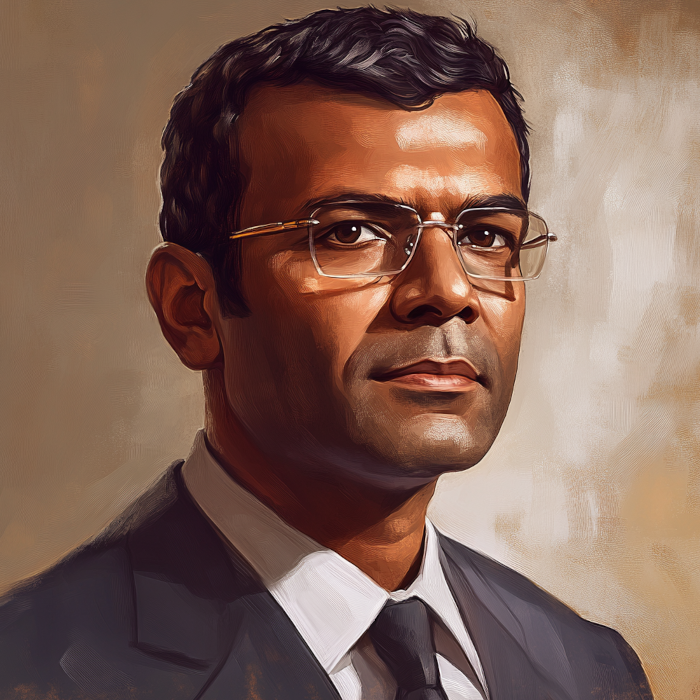
Mohamed Nasheed (born 1967) is a Maldivian politician, environmental activist, and writer who served as the 4th President of the Maldives from 2008 to 2012. He is best known for being the first democratically elected president of the Maldives, ending 30 years of autocratic rule by Maumoon Abdul Gayoom. Nasheed’s presidency focused on democratizing the country, fighting corruption, and raising awareness about climate change, particularly the impact of rising sea levels on small island nations like the Maldives. Despite being ousted from power in 2012, Nasheed remains an influential figure in Maldivian politics and a prominent international advocate for environmental causes.
Birth and Family Background: Mohamed Nasheed was born on May 17, 1967, in Malé, the capital of the Maldives. He came from a politically active family and grew up in the political environment of the Maldives, which at the time was dominated by the authoritarian rule of Maumoon Abdul Gayoom. His family's political background influenced his early interest in activism and democracy.
Education: Nasheed completed his secondary education in the Maldives and later attended Overton College in the United Kingdom before studying at Liverpool John Moores University. He returned to the Maldives, where he became an outspoken critic of the government. He also worked as a journalist and wrote extensively on the political issues facing the country, using his platform to speak out against the Gayoom administration.
Political Opposition to Gayoom: In the 1990s, Nasheed emerged as one of the most vocal critics of Maumoon Abdul Gayoom, who ruled the Maldives with an authoritarian grip from 1978 to 2008. Nasheed’s activism often brought him into conflict with the government, which was known for suppressing political dissent and curtailing civil liberties. He was arrested several times for his political activities and spent significant periods in prison, often under harsh conditions.
Journalism and Advocacy: Nasheed was a journalist for the pro-democracy publication "Sangu" and used his writing to challenge the regime. He was also instrumental in documenting human rights abuses and advocating for political reform. His continued criticism of the government led to his imprisonment on multiple occasions, during which he was subjected to solitary confinement and alleged torture. Despite these challenges, Nasheed remained committed to the fight for democracy in the Maldives.
Founding the Maldivian Democratic Party (MDP): In 2003, Nasheed co-founded the Maldivian Democratic Party (MDP) while in exile in Sri Lanka and the United Kingdom. The MDP became the main political force challenging Gayoom’s rule and advocated for democratic reforms, including free elections, freedom of speech, and an independent judiciary. Nasheed’s leadership of the MDP made him the face of the pro-democracy movement in the Maldives.
First Democratic Elections (2008): In 2008, after years of pressure from Nasheed, the MDP, and international human rights organizations, President Gayoom agreed to hold the Maldives’ first multi-party presidential election. Nasheed ran as the MDP candidate against Gayoom, and, with the support of a broad coalition of opposition parties, he won the election in a runoff, becoming the first democratically elected president of the Maldives on November 11, 2008.
Reforms and Policies: As president, Nasheed focused on a broad range of reforms aimed at democratizing the Maldives. His administration worked to establish independent institutions, freedom of the press, and judicial independence. He also focused on improving public services, such as healthcare and education, and addressing issues of corruption that had plagued the previous administration.
Environmental Advocacy and Climate Change: One of Nasheed’s most notable achievements was his advocacy for global action on climate change. The Maldives, a low-lying island nation, is particularly vulnerable to rising sea levels, and Nasheed used his platform as president to raise awareness about the existential threat that climate change posed to his country. He held the world’s first underwater cabinet meeting in 2009 to draw international attention to the need for urgent action on climate change.
Nasheed committed the Maldives to becoming the world’s first carbon-neutral country by 2020 and sought to invest in renewable energy projects. His bold environmental initiatives earned him international recognition, and he became a prominent voice for small island nations facing the impact of climate change.
Economic Reforms: Nasheed’s government also focused on economic liberalization and diversification to reduce the Maldives’ dependence on tourism, which is its main economic driver. His administration promoted foreign investment and sought to improve infrastructure, including expanding access to electricity, clean water, and transportation services.
Growing Opposition and Tensions: Nasheed's presidency faced numerous challenges, including rising political tensions and economic difficulties. His attempts to reform the judiciary and tackle corruption met with resistance from entrenched interests, and he faced growing opposition from political rivals and Islamist groups. Tensions reached a peak in 2011, when Nasheed ordered the arrest of Abdulla Mohamed, the Chief Judge of the Criminal Court, accusing him of corruption and bias. The move was seen as an overreach of executive power and led to widespread protests against Nasheed’s government.
Forced Resignation (2012): On February 7, 2012, amidst escalating protests, police mutiny, and mounting pressure from political opponents, Nasheed announced his resignation, stating that he wanted to avoid further bloodshed. He later described the events as a coup d'état, alleging that he was forced to resign under duress. His resignation led to political turmoil in the Maldives, with Nasheed and his supporters demanding new elections and investigations into the events leading to his ouster.
Running for Office Again: After his resignation, Nasheed remained active in Maldivian politics, continuing to lead the MDP and calling for free and fair elections. In 2013, he ran for president again, but lost in a controversial election to Abdulla Yameen, Gayoom's half-brother. Many observers, including international bodies, raised concerns about the conduct of the election and allegations of vote-rigging.
Imprisonment and Exile: In 2015, Nasheed was arrested and sentenced to 13 years in prison on charges of terrorism, related to the arrest of Judge Abdulla Mohamed during his presidency. The trial was widely criticized by human rights organizations, including Amnesty International, which called it politically motivated and accused the government of denying Nasheed a fair trial. The conviction effectively barred him from participating in future presidential elections.
In 2016, Nasheed was granted permission to travel to the United Kingdom for medical treatment, where he sought asylum and was granted refugee status. From exile, Nasheed continued to campaign for democracy in the Maldives and became an international advocate for climate action and human rights.
Return to the Maldives: Nasheed returned to the Maldives in 2018, following the unexpected electoral defeat of President Yameen by Ibrahim Mohamed Solih, the MDP candidate. The election was seen as a turning point for democracy in the Maldives, and Nasheed was able to return to his home country without facing imprisonment. After his return, Nasheed was elected Speaker of the People’s Majlis (Parliament) in 2019, a position that allowed him to play a significant role in shaping national policies and governance.
Climate Change Advocacy: Mohamed Nasheed’s most enduring legacy is his role as an outspoken advocate for global action on climate change. He has been a vocal representative of small island developing nations that are on the front lines of the climate crisis, and his efforts have helped bring international attention to the plight of vulnerable countries facing rising sea levels and extreme weather events. His dedication to environmental issues has earned him recognition as a leading global voice on climate action.
Champion of Democracy: Nasheed is also remembered for his efforts to bring democracy to the Maldives, ending three decades of autocratic rule. Despite facing significant challenges, imprisonment, and exile, Nasheed has remained committed to democratic principles and has continued to push for political reforms in the Maldives. His leadership of the pro-democracy movement inspired a generation of Maldivians to demand greater political freedoms and civil rights.
International Recognition: Nasheed has received numerous international awards and honors for his work, including the International Campaign for Human Rights Award from Human Rights Watch and the James Lawson Award for Achievement in the Practice of Nonviolent Action. His story was also featured in the 2011 documentary film "The Island President," which highlighted his presidency and his efforts to address climate change.
Mohamed Nasheed is a significant figure in modern Maldivian history, known for his role in bringing democracy to the Maldives and his global leadership on climate change. His tenure as president was marked by efforts to reform the political system, promote transparency, and combat corruption, while also addressing the urgent challenges of climate change. Although his presidency was cut short by political turmoil, Nasheed's influence on Maldivian politics has endured, and he remains a respected leader committed to democracy, human rights, and environmental protection.
Nasheed's courage in standing up to authoritarian rule, his resilience in the face of adversity, and his commitment to fighting climate change have made him a prominent figure not only in the Maldives but also on the global stage. His legacy as a champion of democracy and environmental justice continues to inspire people around the world.
We use cookies
We use cookies and other tracking technologies to improve your browsing experience on our website, to show you personalized content and targeted ads, to analyze our website traffic, and to understand where our visitors are coming from. Privacy Policy.